
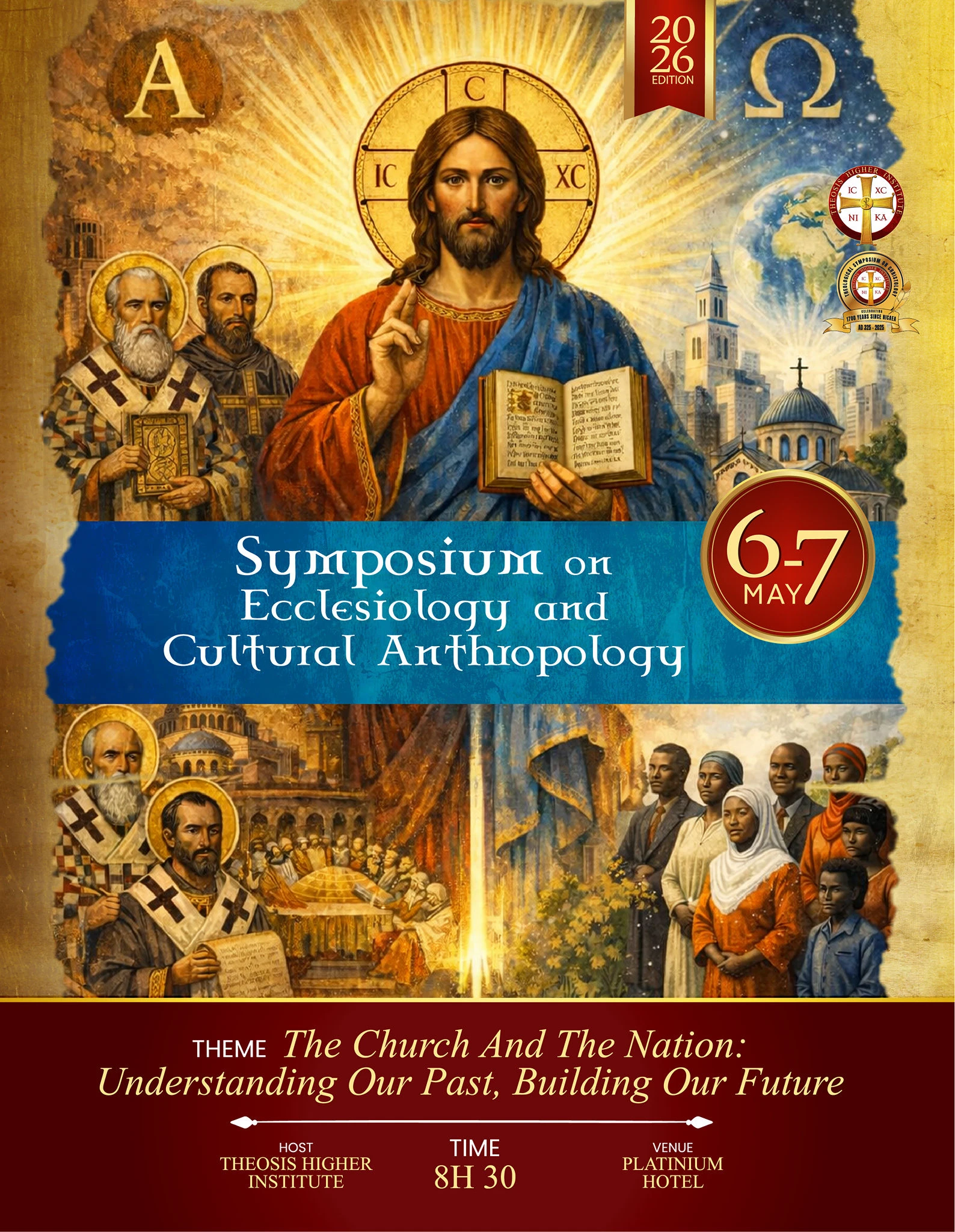
Symposium on Ecclesiology and Cultural Anthropology
"The Church and the Nation: Understanding Our Past, Building Our Future."
A Call for Papers
Overview
Theosis Higher Institute is pleased to invite academic researchers, theologians, cultural anthropologists, and graduate research students to submit paper proposals for our upcoming 2026 Symposium on ecclesiology and cultural anthropology.
At a time when African nations are navigating complex paths toward modernization while grappling with deep-rooted traditions, the intersection of faith and identity has never been more relevant. This symposium seeks to provide a rigorous platform for analyzing the historic and contemporary roles of the Christian Church in education and national development, specifically within the Cameroonian and broader African landscapes.
Core Research Tracks
We welcome submissions that offer original insights, case studies, or theoretical frameworks in the following areas:
- Cultural Anthropology: Investigating the human condition and social structures within the African context.
- Migration and Diaspora: Examining the impact of displacement and movement on faith communities and national identity.
- Traditional Religious Practices: Analyzing the dialogue (or tension) between indigenous African belief systems and Christian orthodoxy.
Inculturation: Exploring how the Gospel takes root in local cultures without losing its essence. - Ecclesiological Implications: Discussing the practical and theological consequences of “The Church and the Nation” for both the institution and society at large.
Target Audience
This Theological Symposium on Ecclesiology and Cultural Anthropology aims to bring together academics, researchers, postgraduate research students of theological institutions, theologians, and clergy. The symposium seeks to foster scholarly engagement and discussion on the historic and contemporary roles of the Christian Church in education and national development, specifically within the Cameroonian and broader African landscapes.
Symposium Objectives
Participants will be tasked with answering a central question: How can the Church’s past inform a sustainable and culturally resonant future for the African nation? Beyond the presentation of papers, this event aims to foster a collaborative network between the academy and the clergy, ensuring that theological reflection leads to tangible societal transformation.
Submission Guidelines
We encourage submissions from established scholars and are particularly committed to providing a stage for graduate research students in Theology, Ecclesiology, and Cultural Anthropology to present their emerging research.
Authors are invited to submit original, unpublished manuscripts in either French or English. These submissions must not have been previously published nor be under consideration for publication elsewhere.
Kindly submit an electronic file containing either an abstract (maximum one page) or a research project (maximum five pages, single-spaced), including the title of the paper and full contact details.
- Abstract Length: 250 – 300 words
- Keywords: 3 – 5 terms
- Biography: A short CV or bio (max 150 words)
- Format: PDF or Word document
- Abstract/Research Project Submission Deadline: April 15, 2026.
- Notification of Acceptance: April 25th, 2026
- Full Paper Submission Deadline (or poster for Post Graduate Students of Theosis Higher Institute: May 2nd, 2026
- Word Limits: Abstracts should be between 800 and 1000 words. Full papers should not exceed 20 pages (1.5 line spacing, including appendices, endnotes, and bibliography).
- Cover Page: The cover page must include:
- The title (maximum 20 words).
- The full first and last name(s) of the author(s) along with their business address(es).
- Their WhatsApp telephone number(s).
- An asterisk (“*”) marking the name of the author to whom correspondence (manuscript for corrections, etc.) will be addressed.
- The author(s)’ address(es), including telephone number(s).
- Second Page: The second page will contain only:
- The title of the paper.
- A summary in French or English.
- Four to five keywords.
- Text Formatting: The main text must be typed on a PC using Microsoft Word software, with the following specifications:
- Font: Times New Roman, size 12.
- Paper Size: A4 format.
- Margins: 2.5 cm on all sides.
- Line Spacing: Single.
- Length: Maximum 5 pages.
- Tables, Diagrams, and Images: Tables, diagrams, images, and other additions should ideally be inserted directly within the text or placed in appendices. Sections should be numbered hierarchically (e.g., 1., 1.1., 1.1.1., etc.).
- Formatting of Specific Elements:
- Title: Times New Roman, size 18, bold.
- Author’s Name: Times New Roman, size 14, bold.
- Abstract and Summary: Headings “Abstract” and “Résumé” in Times New Roman, size 16, bold; content in Times New Roman, size 12.
- Heading 1: Times New Roman, size 14, bold.
- Title 1.1: Times New Roman, size 12, bold.
- Conclusion: Times New Roman, size 14, bold.
- Bibliography: Heading “Bibliography” in Times New Roman, size 14, bold; content in Times New Roman, size 12, formatted as follows:
-
- Books: Author’s last name and first initial, (publication year), Title, Publisher, Place of publication (e.g., Mintzberg, H. (1994), Grandeur et décadence de la planification stratégique, Dunod, Paris).
- Articles: Author’s last name and first initial, (publication year), “Article title,” Journal Title, Vol. x, No. x, pp. x-y, (publication month-year) (e.g., Koenig, G. (1996), “Karl E. Weick,” Revue française de gestion, No. 108, pp. 57-70, March-April-May).
-
-
Note: The journal’s editors reserve the right to modify titles, intertitles, headings, and highlighted texts proposed by the author.
-
-
Recommended Structuring
The text should preferably be divided into the following sections: Introduction; Materials and Methods; Results; and Discussion. Decimal numbering should be used to indicate the hierarchy of divisions and subdivisions, not exceeding three levels. Authors are strongly urged to adhere to proper spelling and grammatical rules.
Titles
The title should be concise and clear, with a maximum length of three lines or 20 words. It should accurately reflect the subject of the article and align with the questions posed in the introduction and the answers provided in the conclusion. The title should be in Times New Roman font, size 14, and in uppercase. An English version of the title should be written below the French version.
Authors
Titles (e.g., Prof., Dr.) should precede the surname(s) and first name(s) of the author(s) and should appear in Times New Roman, size 12, lowercase, and left-aligned. Authors’ contact details (institutional affiliation, professional address, and e-mail address) should be written in Times New Roman, size 10, italics, and left-aligned.
Introduction
The introduction should clearly present the research problem, supported by the most recent and relevant scientific citations (at least five). The objectives of the study must be clearly stated. The text should be written in clear and understandable scientific language.
Materials and Methods
This section should provide a sufficiently detailed description of the methodological approach, including: the type of study; a description of the study population; the data and techniques used for data collection; the main and secondary variables studied; and the statistical analysis methods employed.
Results
Section titles should be left-aligned, without indentation, and use decimal numbering. Level 1 Titles should be in Times New Roman, bold, with 6 points of spacing before and after. Level 2 Titles should be in Times New Roman, bold italics, with 6 points of spacing before and after. Level 3 Titles should be in Times New Roman, italics (non-bold), with 6 points of spacing before and after. Each table, photograph, or figure must have a concise title. Figures should be self-explanatory and visually readable without requiring reference to the main text.
Discussion
The methodological approach used and the results obtained should be discussed in accordance with established academic standards. At least five (5) authors should be referenced within the discussion section.
How to apply
Please submit your abstracts and inquiries to the Technical Committee at contact@theosisinstitute.life or leave a printed copy at our Resource Centre, Deido, Douala, Cameroon.
We look forward to welcoming you to the vibrant city of Douala for two days of profound intellectual and spiritual exchange. Together, let us examine the foundations of our past to build a more resilient future.
Publication Opportunities
All accepted papers will be published in the conference proceedings. For papers with multiple authors, at least one author must register for and attend the conference. Selected papers are expected to be published in a special issue of one of our national and international partner journals.
Symposium Details:
- Date: May 6th – 7th, 2025, at 8:30 a.m
- Location: Platinum Hotel Conference Hall, Bonanjo, Douala, Cameroon.
Contact Information:
Theosis Higher Institute Resource Centre at +237 6 75 59 11 15 / +237 6 91 77 27 88
Email: contact@theosisinstitute.life
Website: www.theosisinstitute.org
Keynote Speakers:
- Prof. Shawn Smith
Additional Information:
Registration for the Symposium is currently ongoing. All postgraduate students of Theosis Higher Institute are expected to be present and fully participate.
We look forward to receiving your insightful contributions to this groundbreaking and important theological discussion.